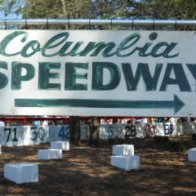
Fayetteville Observer published an article in 2013 about the Harnett ghost track.
http://web.archive.org/web/20170308211853/http://www.fayobserver.com/abb14ddb-1a45-521c-b891-88c6f821d82b.html
Faded memories are all that’s left of the time NASCAR came to Harnett County
By Chick Jacobs Staff writer
SPRING LAKE - Sixty years after preachers fumed and engines screamed and more than 7,000 racing fans hollered one of their own to victory, there isn't much left of Harnett County Speedway.
"A lot of people know there's a racetrack back in here somewhere," said lifelong Harnett County native Pat Flowers. He's one of the few remaining who knows where to look.
"But unless you know where, you might look a long time."
Time and trees have pretty much reclaimed the first track in the Cape Fear region to host a NASCAR Grand National event.
But carefully scramble down what's left of long-abandoned grandstands, hop a 3-foot retaining wall and your footing is suddenly solid.
Sixty years later, there's still a track. The clay is packed so densely that only the most opportunistic weeds have gained a foothold.
That's where, for one weekend in 1953, the red clay of Harnett County became the center of the stock car racing world.
Coy Blue, a Spout Springs native who raced at Harnett County Speedway in the late 1960s, recalled the track as "one of the smoothest around. It was a nice little track up in a holler."
In the early '50s, when the owners of Grannis Farm north of Spring Lake decided to go into the racing business, that holler was a natural half-mile oval.
It was a much easier business to get into 60 years ago. Instead of the gleaming concrete cathedrals that house NASCAR races today, many races were held on tracks about a third the size of today's smallest tracks.
Dirt was the surface of choice. In 1953, 90 percent of races were run on dirt. The average winner's purse was $1,000.
NASCAR, then a fledgling organization, needed a race to replace an early season event in Jacksonville, Fla. A track in central North Carolina seemed perfect - even if it had to be built from scratch.
Flowers, whose family farmed nearby land, could hear the construction from his home on Shady Grove Road. Clay for the track was dug out of a hill. Rows of cinder blocks were topped with 2-by-10-inch slabs of pine for seats. A small cinder block structure was built at the start-finish line, with a concession stand added at the top of the hill that served as grandstands.
Like most small tracks, seating was only on one side of the track, between Turns 4 and 1. The other side, between Turns 2 and 3, was where race crews camped and wrecked cars went to die.
A narrow, bulldozed path between Sandy Grove Road and Bethel Church was named Race Track Road, and fields where tobacco would grow later that summer were cleared for parking.
By the first week of March, everything was ready.
The race buzz arrived well before the gates opened.
The winners of NASCAR's first two races in 1953 were going to be at the inaugural Harnett County Speedway race. Lee Petty, the winner at West Palm Beach, Fla., and Bill Blair, who had won the most recent race at Daytona Beach, Fla., were in the field. So was Tim Flock, the 1952 NASCAR champion.
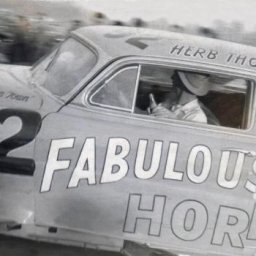
Most fans were pulling for "hometown boy" Herb Thomas, a hard-charging 30-year-old from Olivia. Thomas had finished second to Flock in the previous year's championship battle and had worked through some tough breaks earlier in the season.
With his knowledge of North Carolina clay racing, Thomas was considered one of the race favorites. At the very least, it should be a good race.
Flowers was a young boy in 1953, too young to hike through the farm fields and stands of pine to watch the race alone.
His dad, a churchgoing Baptist, refused to take in such activity on the Sabbath. It wasn't just the temptation to skip church. It was the traffic. People who still live in the area remember the cars on the road more than the ones on the track."There were cars everywhere," said Carl McDonald, who lives on Bethel Church Road. "We'd never seen anything like it."
Preachers in the area lamented the traffic jams that kept churchgoing folks out of the pews.
"Dad was really mad about it," Flowers said. "We went to old Bethel Baptist, and the roads that morning were clogged with cars. You couldn't get there."
Some race fans simply trekked through the fields, avoiding the traffic and the admission charge.
"Us country boys knew our way around up here," Flowers said. "So they'd just hike around the back and walk right in."
By race time, a crowd estimated by race officials at 7,000 had jammed the stands. Others joined the race crews in the infield, braving the dust kicked up on a breezy afternoon.
"They had to get water from Mitchell's Pond next door to damp the track," Flowers said.
According to NASCAR records, Thomas had the pole in his '53 Hudson, with Ohio native Mike Klapak on the outside in a '53 Olds.
It was going to be a 100-mile, 200-lap shootout on a sunny Sunday afternoon. As it turned out, only Thomas came out firing.
He beat Klapak into Turn 1 and didn't let anyone get past him from then on. Two hours later, Thomas was still there, taking the checkered flag for a wire-to-wire win. Dick Rathmann, a California driver, was the only driver within three laps of him at the end.
Thomas' winning speed: 51 mph, slower than the dump trucks that regularly rumble up and down nearby N.C. 210 now.
As the dust settled, NASCAR's best packed up and headed home.
They never came back. A year later, Jacksonville returned to the race schedule, and Harnett County Speedway was closed soon afterward.
NASCAR returned to the area in 1957 and '58, running at Fayetteville's Champion Speedway. New owners sold shares in the Harnett County Speedway, cleaned up the track and ran short-track races in the late 1960s and early '70s.
"You could do a lot more racing for a lot less money back then," Blue said. "A lot of the guys had regular jobs, then raced on the weekend. It was a great little track, and a lot of the local names were there."
In time, the farmland around the track was sold. It now is used for timber and sod farming.
Part of the track's cinder block retaining wall has collapsed. The only spectators now are fire ants in mounds on the back stretch. An empty deer stand stands watch over a cluster of beer cans in Turn 2.
"Before too long, it will all be gone, I reckon," Flowers said. "The folks who own it now say they wouldn't want to put a track on it again. For a while, though, it was the place to be. It was fun, and it was loud."
And in the minds of those who heard the thunder, it remains a rust-colored ribbon, looping into eternity.
Herb won the GN race at Harnett on March 8, 1953.
Here is link to Jim's pic from the race with additional comments.
Finishing order:
| Fin | Driver | Car |
| 1 | Herb Thomas | 1953 Hudson |
| 2 | Dick Rathmann | 1953 Hudson |
| 3 | Lee Petty | 1953 Dodge |
| 4 | Dick Passwater | 1953 Oldsmobile |
| 5 | Herschel Buchanan | 1953 Nash |
| 6 | Mike Klapak | 1953 Oldsmobile |
| 7 | Tim Flock | 1952 Hudson |
| 8 | Ray Duhigg | 1952 Plymouth |
| 9 | Don Oldenberg | 1950 Packard |
| 10 | Keith Hamner | 1952 Hudson |
| 11 | Bub King | 1952 Hudson |
| 12 | Ewell Weddle | 1951 Plymouth |
| 13 | Elton Hildreth | 1952 Nash |
| 14 | Fonty Flock | 1952 Oldsmobile |
| 15 | Coleman Lawrence | 1950 Ford |
| 16 | Fred Dove | 1950 Plymouth |
| 17 | Donald Thomas | 1950 Ford |
| 18 | Jack Lawrence | 1953 Dodge |
| 19 | Harold Nash | 1951 Oldsmobile |
| 20 | Jimmie Lewallen | 1953 Dodge |
| 21 | Dub Livingston | 1953 Dodge |
| 22 | Harry Bennett | 1952 Oldsmobile |
| 23 | Joe Eubanks | 1952 Hudson |
| 24 | Lucky Sawyer | 1949 Ford |
| 25 | Johnny Roberts | 1952 Ford |
| 26 | Weldon Adams | 1951 Studebaker |
| 27 | Bill Blair | 1952 Oldsmobile |
| 28 | Johnny Patterson | 1952 Oldsmobile |
| 29 | Jim Lacy | 1953 Dodge |
| 30 | Curtis Turner | 1952 Oldsmobile |
| 31 | Cotton Priddy | 1951 Oldsmobile |
| 32 | Wally Campbell | 1953 Dodge |
Thanks to Jeff for handling the Legendtorial last night. I missed you all but had a grandson's band concert to attend.
The very first time in his career that NASCAR's all-time winningest GN/Cup driver, Richard Petty ever finished second to the all-time 2nd winningest driver, David Pearson in a NASCAR race was in the 1964 Richmond 250 that began 53 years today on Sunday afternoon March 8, 1964 and concluded on Tuesday night March 10, 1964 under the old half-mile dirt track's original PERMANENT lights following a Sunday afternoon rain stop after 100 laps. I was there both days/nights. It was my first ever race.
The very first time in his career that NASCAR's all-time winningest GN/Cup driver, Richard Petty ever finished second to the all-time 2nd winningest driver, David Pearson in a NASCAR race was in the 1964 Richmond 250 that began 53 years today on Sunday afternoon March 8, 1964 and concluded on Tuesday night March 10, 1964 under the old half-mile dirt track's original PERMANENT lights following a Sunday afternoon rain stop after 100 laps. I was there both days/nights. It was my first ever race.